
Last updated November 17, 2026
 AC repair
 Furnace & heating
 Heat pumps
 Ductless mini splits
 Carrier
 Trane
 Goodman
Seasonal tune-up and full diagnostic on your Carrier, Trane, or Goodman system - readings shown to you before any repair is proposed
Diagnosis first, numbers second - you approve the repair price before a single part goes in.
Get your free estimateFurnace Repair Warning Signs Every Homeowner Should Know
Most furnace breakdowns don’t happen without warning. They send signals for weeks – small changes in sound, smell, and warmth that almost nobody notices because they’re watching for the wrong thing. A yellow burner flame gets all the attention on the internet, but in our experience the sign most likely to leave you heating-less on a cold Nevada night is a furnace that short-cycles. Most homeowners don’t know what that sounds like, so they wait until the house goes cold at 2 a.m. This guide covers the warning signs that actually predict failure, which ones mean “shut it off now,” and a simple monthly check you can run in under two minutes with no tools. If you’re in Enterprise and your furnace is acting strange, this is the page to read before you call anyone.
Quick Answer
The most reliable furnace repair warning signs are short-cycling (the burner fires, runs a few minutes, and shuts off repeatedly), a gas smell or burning-plastic odor, weak or uneven heat, a blower that runs constantly, soot or corrosion on the burners, and a pilot light that won’t stay lit in older units. Smell and burning-plastic signs are safety-critical – shut the furnace off and call immediately. Performance signs like short-cycling mean scheduled repair, not panic, but failing to act on them turns a small fix into a large one.
Styles & brands we work with
- AC repair
- Furnace & heating
- Heat pumps
- Ductless mini splits
- Carrier
- Trane
- Goodman
Table of Contents
- Safety-Critical Warnings vs. Performance Warnings
- Short-Cycling: The Sign Most Homeowners Miss
- Warning Signs Unique to Gas Furnaces in Enterprise, NV
- The Smell, Sound, Feel, See Framework for Monthly Checks
- Which Warnings Turn a $200 Repair into a $1,200 Repair
- What You Should Never Fix Yourself
- How to Stay Ahead of Furnace Failures
Safety-Critical Warnings vs. Performance Warnings
Not every warning sign carries the same urgency. Sorting them into two buckets helps you decide what to do in the next five minutes versus the next five days. Getting this distinction wrong is the most common mistake we see: people panic over a harmless sign and ignore a dangerous one.
Safety-critical: shut the furnace off and call a professional
- Smell of natural gas or rotten eggs. Leave the house, don’t flip switches, and call your gas utility from outside.
- Burning-plastic or electrical-burning smell. Shut the furnace off at the breaker or the switch, and call for service before running it again.
- Headaches, dizziness, or nausea in the home when the furnace runs. This can signal carbon monoxide. Get everyone outside and call for help.
- A carbon monoxide alarm sounding. Treat it as a real event, not a faulty detector.
- Visible soot streaks or a scorched area around the furnace. Sign of incomplete combustion.
Performance-allowed: schedule repair within days
- Short-cycling (repeated on-and-off)
- Weak or uneven heat from room to room
- Furnace running longer to reach the thermostat setpoint
- Clicking or rattling noises at startup
- A pilot light that lights but goes out within a day or two in older units
- Higher-than-usual gas bills without a change in usage
Enterprise sits at the edge of the desert, where nights regularly drop into the 30s and 20s from December through February, and that cold snaps hard on older equipment. If your furnace is showing a performance warning in Enterprise during a cold snap, don’t wait for it to warm up before you call. Call the same day. Same-day furnace repair is usually available, and reaching out early is the difference between a scheduled fix and an emergency visit at the worst possible hour.
Short-Cycling: The Sign Most Homeowners Miss
Short-cycling is when the furnace fires up, runs for a few minutes, shuts off, and then repeats the whole cycle. The pattern sounds like this: burner on for three or four minutes, followed by a blower running a while longer, then a pause of a few minutes, then the burner fires again. A healthy furnace runs through a longer cycle when it’s cold outside – sometimes 15 to 30 minutes at a stretch depending on the outdoor temperature and your thermostat settings. A furnace that cycles every five minutes isn’t working harder; it’s failing.
Short-cycling matters because it directly implicates one of a handful of components:
- Clogged air filter. Restricted airflow causes the furnace to overheat and trip its high-limit safety switch. The switch resets, the furnace fires, overheats, trips again. This is the most common cause and the cheapest fix – often $20 for a filter.
- Failing high-limit switch. The safety switch that shuts the burner off when the heat exchanger gets too hot becomes unreliable with age, tripping earlier than it should.
- Dirty or failing flame sensor. The flame sensor proves the burner is lit. If it’s coated with carbon, it “sees” no flame and shuts the gas valve – often within a second or two of ignition, producing a short on-off pattern that sounds like a click.
- Blocked exhaust flue or vent. The furnace shuts down to protect itself when exhaust can’t escape. This is where performance crosses into safety.
- Oversized furnace or thermostat misplacement. Less common, but real – a furnace sized for a much larger home reaches setpoint too fast, or a thermostat sitting above a heat register is fooled into shutting the call for heat off too early.
If you’re wondering what to do first: change the filter. If short-cycling continues, stop using the furnace to the extent you can and call for furnace repair in Enterprise. Do not try to bypass a limiter or sensor to “see if that fixes it.” Those parts exist to keep the heat exchanger from cracking, and a cracked heat exchanger is a carbon monoxide path into your home.
Warning Signs Unique to Gas Furnaces in Enterprise, NV
Enterprise has a lot of homes built in the 1980s, 1990s, and early 2000s, and plenty of them still have their original or second gas furnace. Older units have behaviors that a newer high-efficiency model simply doesn’t, and if you own one, you should know what’s normal and what isn’t.
Pilot light behavior in older furnaces
If your furnace runs on a standing pilot rather than electronic ignition, watch the color and behavior of that small flame. A healthy pilot burns steady blue with a defined inner cone. A soft, mostly yellow, or floppy pilot that never sits still can mean a dirty orifice, a partially blocked pilot tube, or a draft problem. A pilot that lights but won’t stay lit after you release the knob points to a failing thermocouple – a cheap part, but not one to swap without a meter and a working knowledge of gas valves. Turn the gas off and call.
Signs common to Enterprise gas furnaces
- Yellow, lazy burner flame at the main burners. The flame should be mostly blue with small orange tips. A large yellow, dancing, or lifting flame suggests dirty burners or a combustion air problem.
- Rusty flue pipe or draft hood. Desert-DRY though Enterprise is, our monsoon humidity and cooler nights cause condensation inside a cool flue before the furnace fires. Repeated condensation rusts the flue from the inside.
- Water pooling under the furnace. On 90%+ efficient furnaces, that’s a clogged condensate line or a failing inducer. On an 80% furnace, it’s something else, and you should call.
- Dusty smell at first startup in November. A light dusty smell on the first start of the season is normal – it’s the dust on the heat exchanger burning off. A smell that persists beyond a day, or smells like wires or plastic, is not normal.
- Banging or booming on startup. Delayed ignition. Gas builds up before igniting. Get this looked at before the heat exchanger suffers a shock it can’t take.
- Pilot light or igniter clicking without a burner firing. Igniter or flame sensor problem, or a gas valve that isn’t opening.
If your furnace is a Goodman, Rheem, York, or Daikin unit that’s ten years old or more, whatever warning sign you’re noticing is worth acting on. Parts for the major brands are usually available quickly, and a repair today is often a repair that stays a repair instead of turning into a replacement decision by March.
Need a same-day diagnosis? Call our furnace repair team at (844) 797-9490 for a written, upfront price before any work starts.
The Smell, Sound, Feel, See Framework for Monthly Checks
You don’t need tools or an HVAC certification to catch most furnace problems early. You need a two-minute routine you can run once a month in heating season. We walk every homeowner through this. It’s the simplest way to catch a small problem before it becomes a repair bill.
Smell
Stand in the room with the furnace, or near the return grille. Close your eyes and take one deliberate breath. You should smell nothing but neutral house air. What you don’t want:
- Rotten eggs or gas odor anywhere
- Burning plastic or electrical odor
- Exhaust or “old car” smell carrying into living space
- Musty, wet-dirt smell (can indicate a condensate leak)
Sound
Put your hand on the door of the furnace and listen for a minute while it’s running. The blower should hum steadily. The burner should produce a low, even rush of flame. What you don’t want:
- Clicking that repeats (flame sensor or igniter)
- A thump or boom at startup (delayed ignition)
- Rattling in the blower compartment (loose blower wheel or debris)
- A whine that wasn’t there before (failing inducer motor)
- The repeated on-off pattern of short-cycling
Feel
Hold your hand near a supply register in a far room while the furnace is at temperature. Warm air should arrive steadily and within two or three minutes of the call for heat. What you don’t want:
- Cool or lukewarm air for a long time
- Strong airflow in one room and a whisper in another
- Air that feels damp or humid (can point to a combustion issue)
- Furnace running much longer than it used to reach setpoint
See
Open the blower door only if it’s safe to do so without touching wires – otherwise just look through the louver or remove the easily-removable filter cover. What you’re looking for:
- Filter color and dust level – replace if grey or clogged
- Rust, soot, or scorch marks anywhere
- Water pooling or staining below the unit
- Burner flame color (blue with small orange tips is healthy)
- Pilot light behavior on older furnaces
If you find any safety-critical item in the Smell or See pass, shut the furnace off. If you find only performance signs, schedule repair within the week. A free estimate is available, and often a quick diagnostic on the spot is enough to tell you whether the fix is a filter or a component.
Which Warnings Turn a $200 Repair into a $1,200 Repair
Small furnace problems have a way of cascading. Ignore the wrong sign for a month, and the part that fails isn’t the part that was expensive to begin with – it’s the part it took down with it. Here are the specific chains we see most often, and what each one costs if you act now versus if you wait.
| If you ignore… | What’s originally at risk | Typical cost if caught now | What it can become | Typical cost if ignored |
|---|---|---|---|---|
| Short-cycling | High-limit switch | Filter change, $20; switch replacement, $150 – $300 | Repeated overheat cycles crack the heat exchanger | $1,000 – $2,500 for heat exchanger or replacement |
| Dirty flame sensor | Flame sensor | $130 – $250 cleaned or replaced | Igniter runs continuously, burns out | Igniter + sensor, $300 – $500 |
| Delayed ignition (boom on startup) | Igniter or flame sensor | $150 – $300 | Gas buildup flexes and cracks the heat exchanger | $1,200 – $2,500 |
| Failing inducer motor whine | Inducer motor | $350 – $600 | Blocked exhaust trips the pressure switch, and combustion byproducts back up | Pressure switch + labor, $600 – $900; heat exchanger risk |
| Clogged condensate line | Condensate trap | $100 – $200 to clear | Water backs into the control board | Control board replacement, $500 – $900 |
| Dirty burners on a gas furnace | Burner cleaning, $150 – $300 | Uneven flame creates soot | Soot clogs the heat exchanger, gas pressure problems compound, pilot failure grows | $600 – $1,500 or heat exchanger replacement |
The chain to remember: short-cycling overheats the heat exchanger, and a heat exchanger that’s been overheated repeatedly over a winter cracks. A cracked heat exchanger is the biggest single furnace repair in the book, and it’s the repair we most want to prevent in Enterprise homes. If your furnace fires and shuts off every few minutes, treat it as urgent even if it isn’t dangerous yet.
What You Should Never Fix Yourself
Every repair on a furnace touches either gas, electricity, or combustion. These are not DIY projects. A filter change is safe. A thermostat battery swap is safe. Anything past that puts you in front of a real risk of fire, gas leak, or carbon monoxide exposure.
- Never open the gas valve or pilot assembly yourself. A gas leak from a poorly seated connection can fill a home with explosive gas in minutes.
- Never bypass a safety switch, igniter lockout, or pressure switch. These parts exist to protect the heat exchanger. Bypassing one is how a fire or carbon monoxide incident starts.
- Never service the heat exchanger or flame sensor on the burner side without training. Even with the power off, a small error can create a carbon monoxide path.
- Never use a shop vac around soot or combustion debris. You can redistribute carbon monoxide sources and worsen the air quality in your entire home.
- Never ignore a persistent warning sign because the furnace “still heats.” Plenty of failing heat exchangers still warm a home right up until the day they don’t.
- Never let an unvetted technician into your home. Ask who’s coming before the door opens.
This is where we take a different approach. Every Brandt HVAC technician is background-checked, identity-verified, and badged under our Threshold Verified standard. You receive the technician’s name and photo before the visit. A photo ID badge is shown at the door. If anyone arrives who you weren’t told to expect, that visit is on us and we make it right. Our technicians carry up to 23 years of experience, and every job begins with a written price before any work starts – including on a diagnostic that ends up being simple.
Looking for a full checklist-driven tune-up instead of a one-time repair? See our AC Maintenance in Enterprise page for how we handle seasonal service and what a written report covers.
How to Stay Ahead of Furnace Failures
Warning signs are best caught on a schedule. Here’s the pattern we recommend to Enterprise homeowners, whether your furnace is one year old or twenty.
- Monthly, October through March: Run the Smell, Sound, Feel, See check. Two minutes, no tools.
- Each fall before the first cold snap: Replace the filter and book a professional furnace tune-up. Combustion analysis, blower inspection, and a flame-sensor check catch the parts that fail first.
- Every two to three months in heating season: Replace the filter, more often if you have pets or a lot of dust. In Enterprise, spring winds and desert dust load filters fast.
- Whenever you notice a new noise, smell, or color: Don’t give it two weeks to see if it goes away. Furnaces don’t self-heal.
- Every year regardless of age, once a furnace passes the 15-year mark: Ask for a heat exchanger inspection by name. It’s the one repair you want to find before it finds you.
For the complete picture on the heating side, our Furnace Repair in Enterprise page walks through our diagnostic process and what a written price looks like. For cooling-season service, start with AC Repair in Enterprise, and for the full scope of who we are and how we vet every technician, see the Brandt HVAC Enterprise home page.
Common Mistakes to Avoid
- Waiting for the yellow flame. A yellow burner flame is worth checking, but by the time a flame turns yellow, soot is often already forming on the heat exchanger. Short-cycling and delayed ignition are earlier, more reliable warnings.
- Assuming the filter was just changed. Filters in Enterprise clog faster than most homeowners expect because of desert dust. Change it before the panic, not after.
- Resetting and hoping. Bumping the breaker or flipping the thermostat off and on to “clear the problem” resets the symptom, not the cause. Short-cycling comes right back.
- Slapping the furnace to get it going. A whack that gets a stale blower spinning is a blower that needs replacing. You’ve just aged the motor and endorsed a bad habit.
- Ignoring a dusty smell that never goes away. The first-start dust smell should clear within a day. One that lingers all winter is a filter, blower, or heat exchanger problem.
- Letting a pilot light “go out and relight” repeatedly for a week. A pilot that won’t stay lit is telling you the thermocouple or gas valve needs attention. Relighting it over and over doesn’t make it safer.
- Booking a technician based on price alone and never asking who’s coming. A lower price from a company that won’t tell you the technician’s name and photo before arrival isn’t cheaper – it just moves the risk to your front door.
See the difference
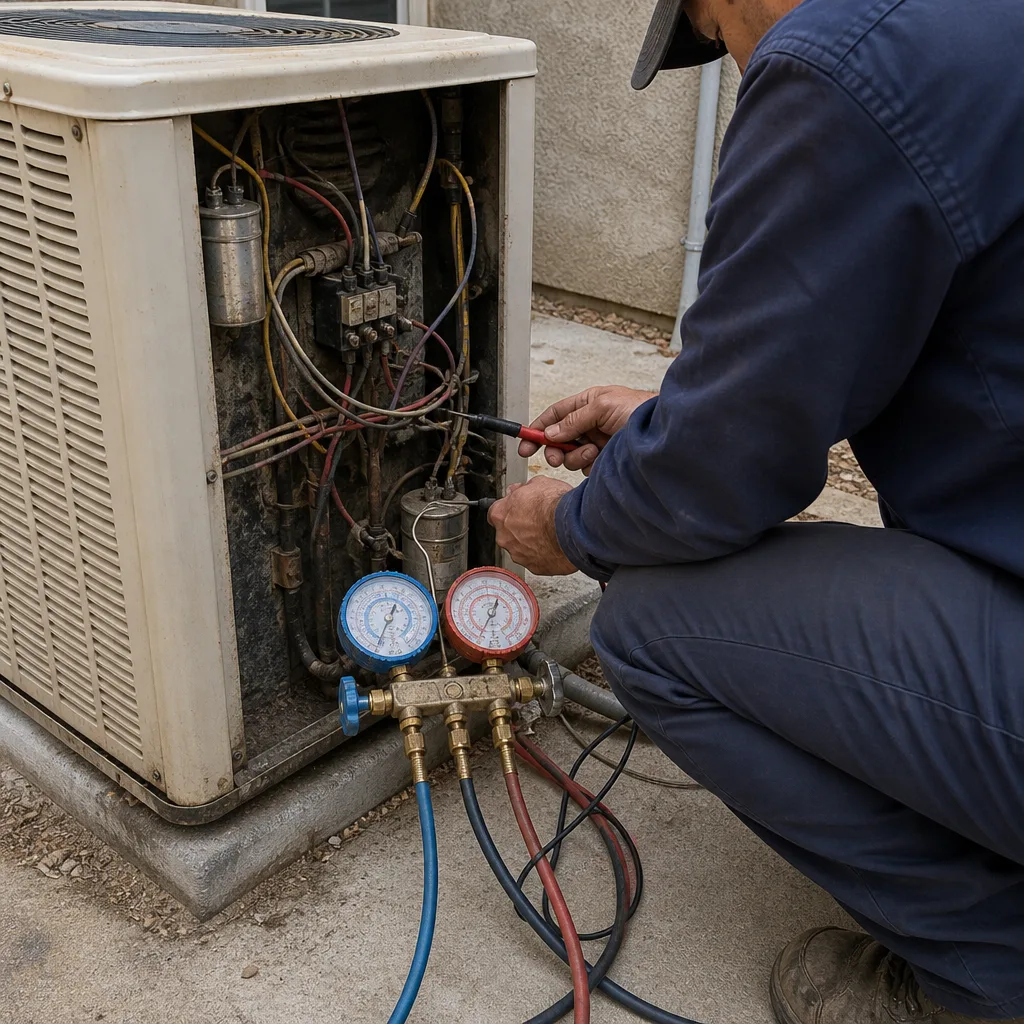 Before
 After
 Before
 After
 Before
 After
When to Call a Professional
Call for furnace repair today if you smell gas, notice a burning-plastic or electrical odor, or see soot, scorch marks, or a persistent yellow burner flame. Call within 24 hours if your furnace short-cycles, booms on startup, won’t stay lit, produces weak or uneven heat, or has left you resetting the thermostat more than once. On an extremely cold night in Enterprise, a failed furnace is a health concern, not just an inconvenience – same-day repair is available and 24/7 emergency calls are answered by a live person, never voicemail. Call our furnace repair team at (844) 797-9490 for a free estimate. Every repair includes a written price before work starts and a written guarantee backed by our 365-Day Done Right Promise.
Frequently Asked Questions
Short-cycling – a furnace that fires, runs a few minutes, shuts off, and repeats – is the most common early warning sign of an imminent failure. It usually points to a clogged filter, a failing high-limit switch, or a dirty flame sensor. Call for a diagnostic if it continues after a filter change: (844) 797-9490.
A yellow main burner flame can indicate incomplete combustion, which is a carbon monoxide risk, but it is not the earliest warning sign. The flame should be mostly blue with small orange tips. A yellow, lazy, or lifting flame warrants a service call the same day, and if you also smell gas or burning, shut the furnace off and get out.
In our experience, most furnace repairs in Enterprise fall between $150 and $600, depending on the part. Filter changes are $20-$30, flame sensors and igniters run $130-$300, blower motors and inducer motors fall in the $350-$650 range, and heat-exchanger repairs start around $1,000 and often point to replacement. Every job begins with a written price before any work starts – call (844) 797-9490 for a free estimate.
Only the filter and thermostat batteries are safe for a homeowner. Anything involving gas, electricity inside the cabinet, the burner assembly, the flame sensor, or the heat exchanger should be handled by a trained technician. Bypassing a safety switch or opening the gas valve yourself can cause a fire or carbon monoxide incident.
Ask the company before booking, and expect a specific answer. Every Brandt HVAC technician is background-checked, identity-verified, and badged under the Threshold Verified standard. You get the technician’s name and photo before the visit, and a photo ID badge is shown at the door. If anyone arrives who you weren’t told to expect, that visit is on us and we make it right.
Every repair we perform includes a written guarantee, and if it fails within the guarantee period, we return free of charge under our 365-Day Done Right Promise. That applies to repeat visits, no argument, no additional charge. To book service, call (844) 797-9490 for a free estimate.
The Bottom Line
Most furnace failures announce themselves weeks before they take your heat. The signs worth watching are the ones that come quietly – short-cycling patterns, weak heat, delayed ignition, a filter that never quite gets changed. The yellow flame everyone talks about matters, but by the time it shows up, the repair has usually grown. Run the Smell, Sound, Feel, See check once a month in heating season, act on performance warnings within days rather than weeks, and shut the furnace off immediately for any safety-critical sign. If you want an expert to look at it, call (844) 797-9490 for a free estimate and a written price on the repair.
Written by the team at Brandt HVAC Enterprise.